About Me

My photo
Project, Plant Engineering and Process Consultant to Fiber Cement or Calcium Silicate Board and both Light Concrete AAC and NAAC-CLC

Tuesday, April 9, 2013

Hatscheck and Flow On Machine Manufacturing - Capacities up to 8 Millions M2/year

                                                                    Vat Cylinder


                                                        Frame Body Hatscheck Machine


                                                        Frame Body Flow On Machine

                                                                         Stacker
                                                          

                                                                Lifter - 20 MT


                                               Warehouse Area Machine Manufacturing

Double Wide Flow On Machine To Making Fiber Cement Board

 
                                   Double Wide Flow on in FCB Plant - 7-8 Millions M2/years


                                              Machine Manufacturing of Flow on Machine


                                                   Machine Manufacturing of Stacker

Saturday, August 25, 2012

NATURAL FIBERS -as Subtitute for Asbestos


How strong this fiber ?  book weight is 380 gram

Sisal fibre is obtained from Agave sisalana, a native of Mexico. The hardy plant grows well in a variety of hot climates, including dry areas unsuitable for other crops. After harvest, its leaves are cut and crushed in order to separate the pulp from the fibres. The average yield of dried fibres is about 1 tonnes per hectare, although yields in East Africa reach 2.5 tonnes.

The fibre

Lustrous and creamy white, sisal fibre measures up to 1 m in length, with a diameter of 200 to 400 microns. It is a coarse, hard fibre unsuitable for textiles or fabrics. But it is strong, durable and stretchable, does not absorb moisture easily, resists saltwater deterioration, and has a fine surface texture that accepts a wide range of dyes.
CNR-ISMAC, Biella, Italy

Uses of sisal


Sisal is used in twine and ropes, but competition from polypropylene has weakened demand.
 
But other markets are emerging - today, sisal can be found in speciality paper, filters, geotextiles, mattresses, carpets and wall coverings.
 
It is used as reinforcement in plastic composite materials, particularly in automotive components, but also in furniture. Another promising use is as a substitute for asbestos in brake pads. (It is also the best material for making dartboards.)
By-products from sisal extraction can be used for making bio-gas, pharmaceutical ingredients and building material

more info as reference

Saturday, June 23, 2012

WHITE ASBESTOS ( CHRYSOTILE) IT'S STILL A KILLER ?

Please see to Caution or Danger of this products
Please take care in safe on handling process

http://www.ehow.com/about_6513591_information-chrysotile-white-asbestos.html
Mining companies argue that the body can clear chrysotile asbestos fibers from the lungs and that as a result, chrysotile asbestos poses no health risk. In a paper titled "Undeniable Facts about Chrysotile," its proponents claim that not only does chrysotile have less risk than other forms of asbestos, but also that at low exposure levels, it produces no risk at all. Doctors and scientists counter with the statement that all forms of asbestos cause cancer. According to Mesothelioma.com, a site about asbestos-related cancers, doctors say no amount of asbestos of any form is safe. In 2007 Occupation and Environmental Medicine published a follow-up study of chrysotile asbestos textile workers in South Carolina. The doctors and researchers concluded that the study confirmed the findings from previous investigations of increased risk of death from lung cancer and asbestosis and a strong correlation between exposure to chrysotile and mortality from lung cancer and asbestosis

Sunday, February 19, 2012

New Manufacture of Fiber Cement Roofing from Serang - Indonesia


New Manufacture of Fiber Cement Roofing and Board was located at Serang - Banten in Indonesia.


The factory were producing all kind of grade and the size length from 1.5 m to 3 m.


The products were distributed to West Java, Central Java, East Java and Sumatera Area.


Joint foto with one of key persons in PT. SMIM ( Mr.Warsono ).


Taken at Warehouse Area - Feb 15' 2012.

Wednesday, February 15, 2012

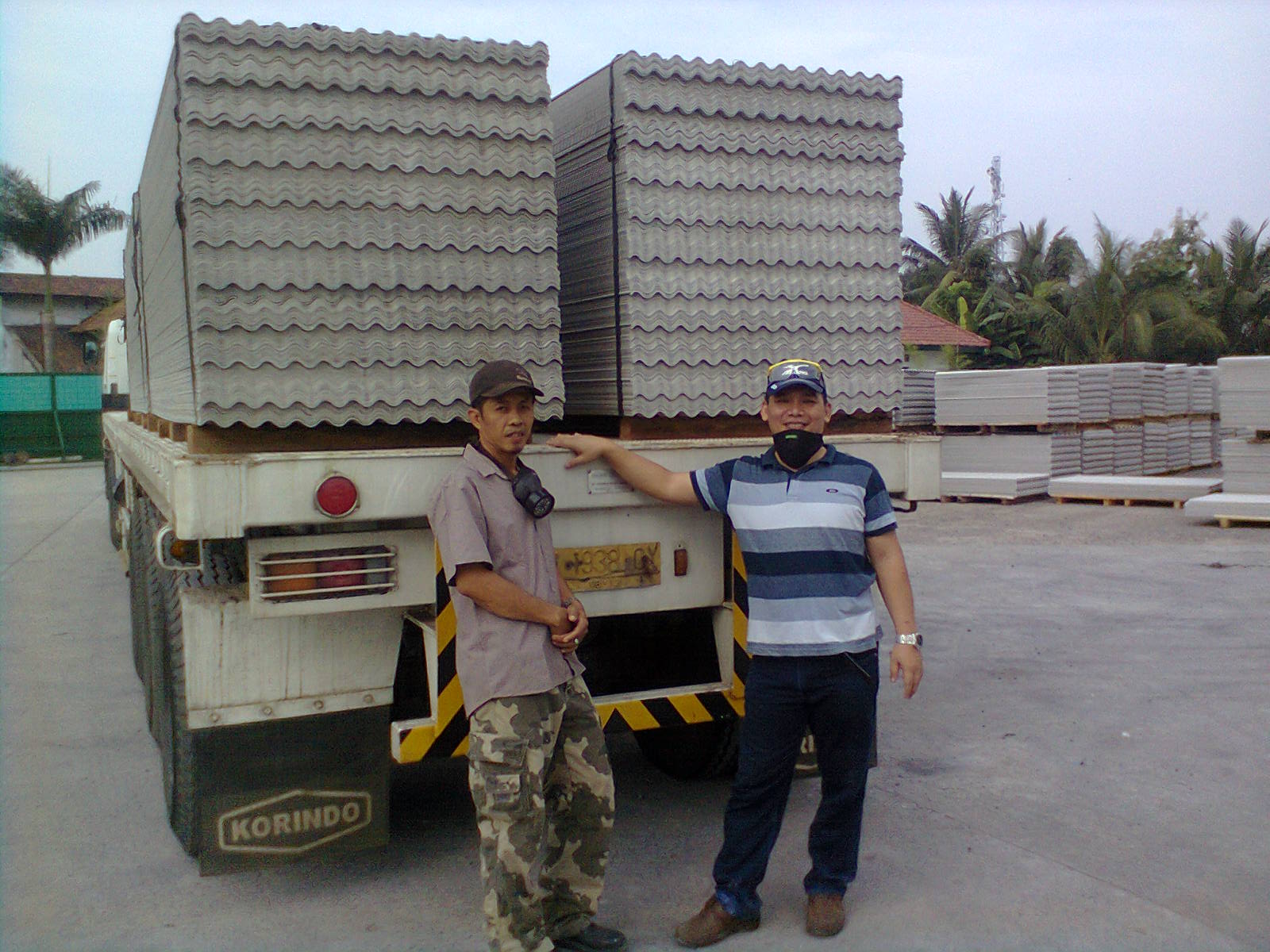
New Manufacture of Fiber Cement Roofing in Serang - Indonesia


New comer to producing of Fiber Cement Roofing was located in Serang-Indonesia.

Ficture was taken while loading the products for Central Java Area.

Congratulation and Succesess.

Sunday, August 14, 2011

How To Protecting Organic Fiber - Cellulose Fiber from Alkalinity Cement ?

Cellulose Fiber Was Protected with Anti Alkalinity ( MAK-AA ).

Chemically treating cellulose fibers to impart the fibers with hydrophobicity and/or durability, and making cellulose fiber reinforced cement composite materials using the Chemical / Additive MAK-AA treated cellulose fibers which the cellulose fibers are treated or covering / protected with specialty chemicals MAK-AA that impart the fibers with higher hydrophobicity by partially or completely blocking the hydrophilic groups of the fibers.

This technology advantageously provides fiber cement building materials with the desirable characteristics of reduced water absorption of Cellulose Fiber have advantage reduced rate of water absorption which content of Alkalinity components from cement, which was lower water migration will be impacted to lower water permeability so the final products made from these materials have improved freeze-thaw resistance, reduced efflorescence, reduced dissolution and re-deposition of water-soluble matrix components in natural weathering.

Using MAK-AA almost to improve other product properties to the physical and mechanical of final product.

As results of using MAK-AA
i.e the bending strength was increased 10 - 12 % with using 0.05 % of MAK-AA from total weight.
Data was taken from Flat Sheet Calsium Silica Board Product.